My mom and I used to watch beauty pageants growing up, from our city pageant that aired on our local cable network all the way up to the biggest national pageant of them all, Bb. Pilipinas. We would stay up together until it finished which is usually past midnight.
I was invested on how amazing they were on that stage and how they answered the Q&A portion on the spot while a camera sat just a few distance from their face and the audience waited for them to fumble, but they didn’t. Also, the way they looked flawless and poised became a dream I assumed I would grow into if I paid close enough attention.
To give you a sense of just how deep I was in it, I can still remember every woman who won our city pageant and every titleholder who won the Big 4 pageants. I followed the pre-pageant activities the way some people follow the NBA preseason. I refreshed Missosology like it was a news site, read pageant reviews, and had a circle of gay friends who loved all of it as much as I did, which meant every coronation night came with a chat that started buzzing the moment the top twelve was announced and did not stop until we had dissected every parts of it.
I say all of this so you know I am not writing from the outside looking in. I was a fan who had favorites, who remembered the top fives from years past, who could tell you which candidate had the best walk and which one deserved the crown she did not get.
Before I spend the rest of this post taking apart something I used to love, I owe you the truth about how much I loved it.
The crown meant something to me back then
My younger self perceived beauty queens differently. These women represented everything I was trying to become which is having grace, intelligence, and poise. The idea that a woman could be admired for more than just her looks, if she had the right answer to the right question.
In a country like ours, pageants are a national sport. Wanting to be one of them felt like wanting to be somebody and I wanted to be that somebody, back then.
I was an overweight kid who got bullied. By the time I hit my teens, I started going into diets and rigid exercise routines in order to chase the thin standard. The shift came slowly since I was a late bloomer.
At some point, people around me started looking at me differently. You are tall, they said. You have a wide smile. You have straight teeth, which I did, not because of braces but because my mom had been particular about my teeth since I was small.
You have potential, they kept saying, in that particular Filipino way where the sentence never finishes because both of you already know what it means. Potential to become one of them.
I believed it, partly because I wanted to, and partly because I thought I had the other half of the formula too. I was a good student and I am confident with my English communications skills, so I was convinced I could ace the Q&A if I ever got there. Eventually, I would be the girl who delivered the kind of answer people replayed on Facebook the next day.
In all of this, I was also watching America’s Next Top Model, which blurred the line between pageantry and modeling in my head until they became one big dream wearing two different outfits where Tyra is telling girls to smize, then it felt like it belonged in the same aspect as a pageant coach telling a candidate to sharpen her walk.
I have written the full story of that pageant dream somewhere else which I’ve linked below for the story.
Related Article: I No Longer Dream of Becoming a Beauty Queen
To sum it up, I was not just a fan of beauty queens. I wanted to be one, amid the people around me who kept on telling me that it was possible, which is a dangerous thing to tell a girl who is already at war with her body.
The first crack that costed me fifteen years
I had an eating disorder for fifteen years of my life which was long enough that it stopped feeling like a phase and started feeling like a personality and long enough that I forgot what it was like to listen to my hunger and fullness cues.

I studied the women’s physiques from photos and videos I looked at on social media and the internet. Through time, I felt that my own body never passed the test. Every pound I lost felt like progress. Every pound I did not lose felt like failure. There was always another centimeter to chase and another angle to correct. The mirror was never on my side because the standard it was comparing me to was not real.
The women I was starving to resemble were often hurting, as well. The industry that produced them ran on cosmetic enhancements and surgeries, training camps that treated bodies like projects, and disordered eating dressed up as discipline.
I have written about this part of my life in more detail elsewhere. One post is about my pageant dream and how it tangled with the way I saw my own body. The other is the full story of my eating disorder and what recovery looked like. This post is not about the disorder itself. It is about the stage that helped plant it.
Related Articles:
However, fifteen years of a bad relationship with my body was only the first crack. It was not yet the thing that ended the fandom which came later.
The last straw and the open secret nobody wants to say out loud
My fandom ended for good when I read threads on Reddit about certain allegations and stories about pre-pageant events where the meet and greet was not really a meet and greet.
Then, the ones that carried the most weight was a former queen who coming forward when she relinquished her crown because of some untoward incidents.
In Reddit, some named the arrangements directly and some only hinted. Yet, the pattern is already there over the years regardless of any pageant.
They said that some queens had sponsors in the other sense of the word. That the lifestyle, the gowns, the travel, the upkeep of a face and body that could keep winning, was financed by arrangements nobody placed on a resume. I am not naming names and I cannot prove anything. The point is that the rumor has persisted long enough from enough different conversations and that dismissing it as gossip stopped feeling honest. We all know, but we just do not say it.
If you look at it in a societal lens, you see it everywhere else. Look at who the beauty queens tend to end up with. They’re the politicians, the businessmen, and/or the men with security details and surnames that open doors.
Over and over, the titleholder becomes the girlfriend and eventually, the wife of someone already powerful. Nobody in the room acts surprised. It is treated like the expected ending, as if the queen becomes a trophy on a shelf that was built long before she walked the stage. You start noticing which husbands and men collect them the way others collect watches.
I want to be careful here as this is not to say that all beauty queens have engaged in these activities. Also, some of these women are victims too. They do not deserve to be blamed for what the industry around them made possible. Some were young and some were poor. Some were groomed into arrangements they did not fully understand until they were already inside them. Some were told outright that this was the price of the crown and that saying no meant going home.
It is easy from the outside to judge a woman for the choices she made to survive a system that was rigged before she ever entered it. The women are not the problem. The system around them is.
That was the part that stung. The pageant economy demands a look that costs money most of these girls do not have, so the money comes from somewhere. Everyone in the industry knows where.
The crown was not the prize. It was just the receipt.
Filters, photoshop, and social media
In my teenage years during the late 2000s and before social media came, the pageant was at least contained. One night a year, maybe a week of coverage around it, and then the country moved on until the next year. You could turn the TV off. Now, the distorted face and physique lives in every teenager’s pocket, every hour of the day, and there is no off button.
The faces we’re seeing are not even faces anymore. They are projects. The images we scroll past are filtered, airbrushed, slimmed, and rebuilt in Photoshop or other photo editing apps. You see skin without a single pore, waists narrowed past what a spine can hold, jawlines sharpened, noses trimmed, thighs smoothed, you name it. What used to require a glam team and a magazine deadline now happens on a phone before lunch.
Then, there is the lifestyle content layered on top. The posts about what they used to eat and what they eat now instead. The morning routines that start at four. The workouts that assume you have no job, no kids, no commute, and a paid private trainer. It is framed as inspiration, but it reads as instruction and this instruction is impossible.
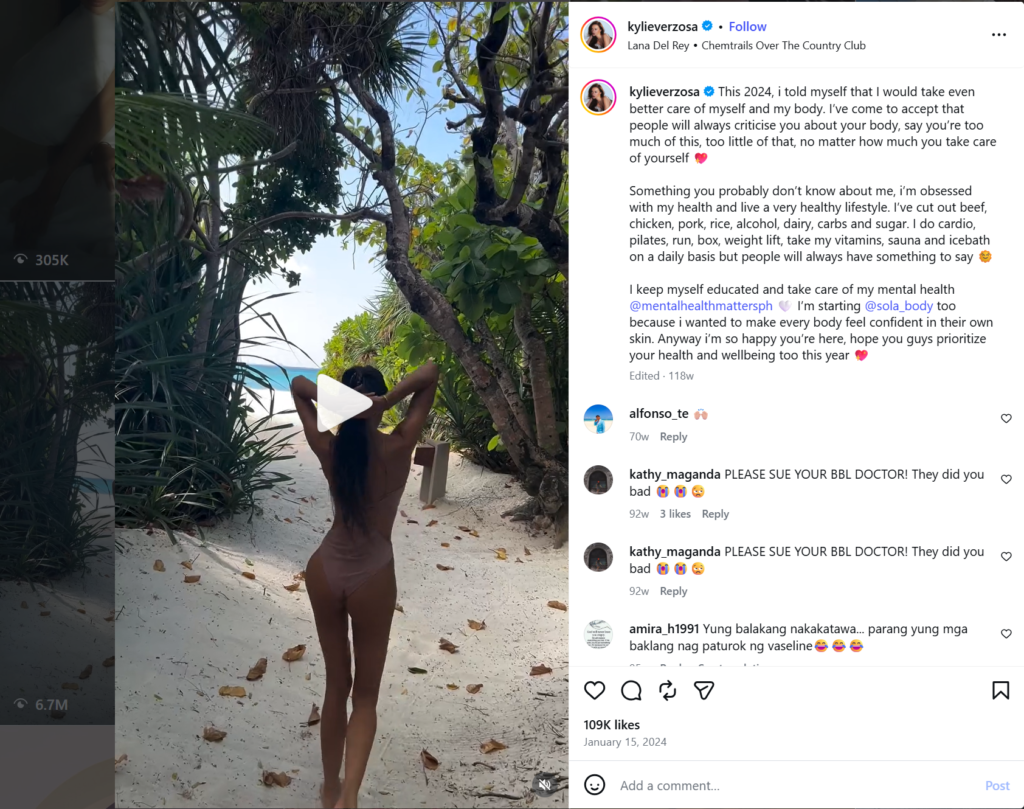
A regular person following that routine will not end up looking like the person who posted it. They will end up tired, hungry, and convinced they are the one who failed.
This is not a good role model for young girls. I know, because I was that young girl once, and the version of this that existed in my time was already enough to put me at war with my body for fifteen years.
The girls growing up now are dealing with a version that is louder, faster, and algorithmically tuned to keep their faces glued on their screen. A girl today is not anymore competing with Miss Universe. She is competing with a version of herself that does not exist, built by an app, posted on social media, and refreshed every time she opens her phone.
If you’re a Filipino, pageants are everywhere
Pageants are a Philippine cultural habit. It has been in our culture since the Spanish period. Every school has its Mr. and Ms. Intramurals. Every barangay fiesta has its Mutya. Every company’s annual gathering or sports fest ends with a swimsuit round. Even student organizations run pageants during annual general assemblies. We have made a parade of physiques feel as normal event.
I know because I lived inside it. I witnessed in college where pageant was part of the calendar, then later stepped into workplaces where it somehow still was.
The year I was a newbie at a bank I previously worked with, I ended up representing our cluster in the company’s regional sportsfest pageant. I prepared the only way the format seemed to reward, by going to the gym consistently and working on my body, because the program did not even have a question and answer portion. There was nothing else to prepare for.
The winner that year was the candidate in the sexier outfit, which was not my style, and the judging panel was made up entirely of male executives of the bank. I do not need to finish that sentence for you to know how it ended.
Around the same time, I was also paying my own money to attend a modeling workshop that ran for a month, taught by local photographers and models, and ended in a fashion show at a mall. Somewhere in the middle of rehearsals that kept us out until two in the morning, listening to fashion models describe the diets and routines that kept them thin, wearing clothes I would never choose for myself, I remember reflecting on myself: what is all of this for? I have written about that phase of my life in more detail here.


Yet, imagine if we poured the same budget, the same rehearsal hours, the same full production treatment into science fairs, robotics competitions, research symposia, or cultural showcases that export globally what Filipinos actually build and know.
We have brilliant kids winning international olympiads quietly, while the Mr. and Ms. Foundation Day gets a live band, a sponsored crown, and a full-page feature in the school paper. A corporation spends its sportsfest budget on a swimsuit round instead of a hackathon. That is a choice a culture is making repeatedly.
Why it’s not empowering
Pageants have been branded as women empowerment. The swimsuit round became body confidence. The advocacy segment became platform. The whole machine learned to speak the language of women’s liberation while still asking women to stand in a line and be ranked.
I would believe pageants are empowering that day comes when they put women of different sizes on the same stage. A size 14 next to a size 1, a soft belly next to a flat one, stretch marks that were not edited out, and a body that looks like most of the women watching at home. Yet, that is not the show we get.
The bodies on that stage still all look like variations of the same body and calling that diversity does not make it diverse. It just makes the language prettier while the standard stays the same.
I am not buying it anymore. Empowerment that requires you to shrink, smile on cue, and stay silent about the parts that hurt is not empowerment, but a performance with a sash. You can admire an individual woman’s intelligence, her advocacy, her work, without endorsing the machine that packaged her. Those are two different things, yet we keep letting the industry collapse them into one so we do not have to ask harder questions.
When that machine runs all the way from the Miss Universe stage down to a grade school auditorium and a corporate organization’s annual general assembly, it is training girls to believe that being looked at is the highest thing they can aspire to, training boys to believe that ranking women is a normal thing to do that evening, and training all of us to clap for a version of womanhood that costs the woman far more than it ever pays her back.
What I’m rooting now instead
I am not here to burn it all down or shame anyone still watching. You can keep following your favorite queen, but I just root for different things now. These are women who are admired for their work, their minds, and their kindness. Schools that crown the student who built the thing, not the one who walked the best in heels. Young girls who grow up knowing that a crown was never the point.
However, some of the women I once admired in gowns I still admire now, but for different reasons. They’re the ones who went on to build careers in science, technology, media, business, advocacies that are worth it, and the likes. That is the part that’s always worth watching. Her sash faded, but the woman underneath kept going. Most of them would probably tell you the crown was a doorway, not the destination, and the real work started the day they took it off.
If I ever have a daughter or know a young girl, I will not be the one handing her a pair of heels and telling her she has potential. I will not sign her up for the modeling workshop. I will not nudge her toward the local pageant because people keep saying she has the face for it.
She can be beautiful without being on display. She can be intelligent in her own way and in her own field by solving whatever problem in our society she decides is worth her life.
She can be a productive citizen, which is a much longer job than a reign, and a much better one. Yet, if she still wants to watch a pageant someday, the way my mom and I used to, she can. I just will not be teaching her that the women on the stage are what she is supposed to become.
What I want the next generation of women to see is not the glitz and glamour on stage. It is the woman who moved past the stage that made her famous and someone who was never told she had to stand on one at all.

Leave a Reply