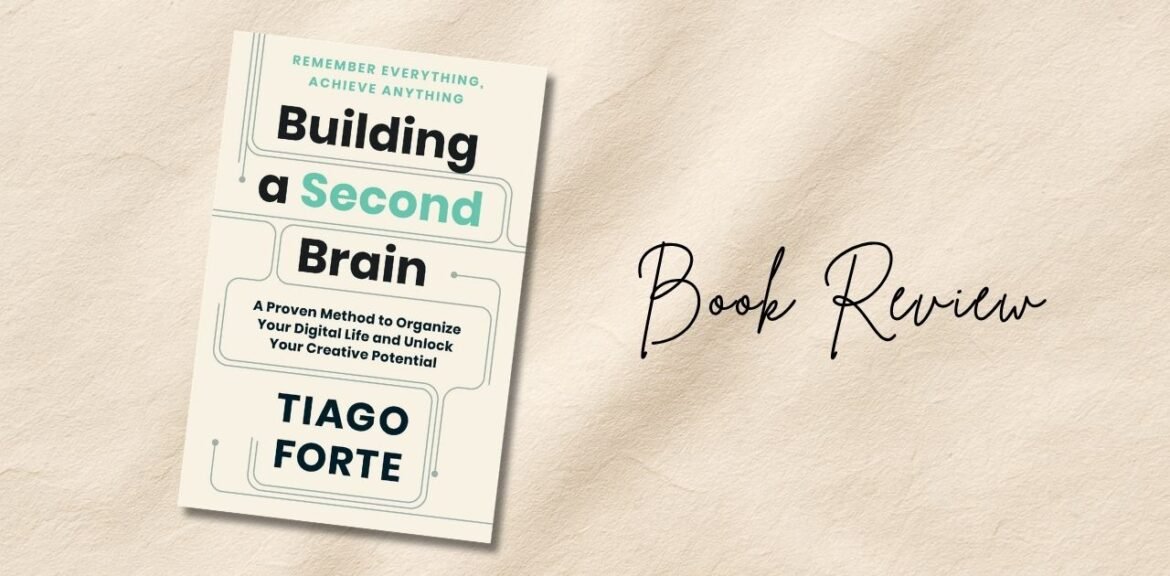
I ran across Tiago Forte sometime in 2024 when he guested on Michael Stelzner’s Social Media Marketing Podcast. I listened to this podcast episode and I found it interesting. His reason for organizing and digitizing his notes was because of his mysterious chronic medical condition that not a single doctor could diagnose and treat. This became the foundation for him to write the book, Building a Second Brain.
After listening to that episode, his takeaways lingered in me within the span of 2 years, which made me interested to read this book someday. It was really this year that I strongly became interested in it, since as a result of busyness, my digital files and work notes have become cluttered over the past year. I thought I could most likely pick up ideas from this book that I could implement.
Book overview
Main problem the author tries to fix
The book’s introduction lays out the core problem that Tiago Forte is trying to solve. That is, our human brains are for creating ideas and not storing them. In this digital age, we’re constantly consuming information, ideas, and insights. Yet, without a system to capture and organize these ideas, most of these slip away before we can ever use it. The author argues that this mismatch is why we often feel overwhelmed and unproductive despite working hard.
His solution is this second brain which is a trusted external system for storing our ideas, memories, and notes. Eventually, this frees up our first brain which is the human brain to do what it does best through thinking and creating. The author structures the book around how building this second brain can help us unlock our full potential.
The book’s framework
Tiago Forte wrote the book through a mix of personal stories, borrowed research, and actionable frameworks.
First, the backbone of the book is CODE (Capture, Organize, Distill, Express). This is his four-step process for turning scattered information into something usable.
- Capture means saving ideas and resources that resonate with you.
- Organize is sorting them by actionability rather than by topic.
- Distill is trimming notes down to their essence so your future self can grasp them at a glance.
- Express is turning your stored knowledge into finished work, whether that’s a project, a piece of writing, or a decision.
Next, the author introduces the PARA method (Projects, Areas, Resources, Archives) which is another book he wrote that I’m currently reading (I’ll write another book of review of this once I’m done reading it). The PARA method is a system for organizing digital files and notes, not by subject, but by how actionable they are.
- Projects are short-term efforts with a clear goal.
- Areas are ongoing responsibilities you maintain over time.
- Resources are topics of interest for future reference.
- Archives are inactive items from the first three categories.
Lastly, the book also walks through smaller techniques that support the two frameworks. The two that I like are helpful in my work and personal for personal usage are:
- Progressive Summarization, where you highlight and bold the most important parts of a note in layers, so the most valuable ideas rise to the top over time.
- Intermediate Packets, small chunks of past work (an outline, a summary, a draft) that you save and reuse instead of starting from scratch every time.
Personal impact
Though the book could have simply been written as an essay, I found it helpful that the author emphasized more on the importance of taking notes. We were taught to take notes back in school, but I never imagined it would benefit my career and personal life the way it has.
For me, the frameworks mentioned are easy to use and implement. As I was reading the book, I started applying the PARA method to organize the folders on my laptop. This method helps me keep in mind which folders I need depending on my current priorities.
In terms of note-taking, I mentioned earlier that I’ve been messy and cluttered with my notes and digital ideas. I used OneNote in the past, but I didn’t find its features flexible enough for what I wanted, and it felt outdated. I also tried Obsidian. It’s really good, but I wasn’t willing to pay a fee just to sync my notes across devices. That’s why I decided to use Notion to implement the PARA method.
So far, it’s been working for me. As the book mentions, our second brain should be a working system we go back to regularly, not something we set up and leave untouched. That has been my experience with the PARA method using Notion.
Notion has also been useful for saving social media ideas from LinkedIn. The app connects with a Google Chrome extensions, which makes it easy to save content ideas directly to Notion.
Similarly, this book didn’t exist when I was a college student. It also didn’t exist at the start of my career, especially during my grad school years. I was already organized as a student. I still am now, but I didn’t have the systems in place to implement that type of organization, especially with a busy life.
In grad school, I did research as part of the requirements. I searched for articles, studies, and other resources to support my research. Distillation and Progressive Summarization are things I could’ve implemented to streamline my research, instead of saving sources in a Chrome tab or Word document, then forgetting them or scrambling through documents when I needed them.
Moreover, the part I was looking forward to was for the author to suggest a specific note-taking app to use. I understand that he mentioned in the book that he’s not recommending a specific app, since it depends on whether it’s useful or applicable to you. The author only enumerated some apps that are useful for note-taking. At the same time, some parts felt like he was pitching his course throughout the book.
Who is this book for and should you read it?
Building a Second Brain is for beginners who need a starting point for organizing their digital files and notes. I believe this isn’t for those who already have systems in place that work for them. It’s also for curious individuals like me, who are seeking to improve how they organize and manage their digital notes and files amid a busy life bombarded by social media noise.
If you’re a student or someone starting their career, this is a book I wished I had read during my younger years, as I mentioned earlier. However, since it was only released in 2022, by which time I had already graduated from my master’s, that wasn’t possible.
This book is also for knowledge workers who constantly scramble with their processes, keep forgetting how to do stuff, and keep their notes in a Google Doc, Microsoft Word doc, or sticky notes. I, for one, had been there. Even though no one on your team habitually takes notes, if you start doing it, you could become an indispensable asset to your team which something I wish I could’ve done earlier in my career.
Overall, I recommend this book and I recommend implementing the frameworks and methods that apply to your current life as soon as you finish reading it. Apply what works for you and disregard what doesn’t.






Leave a Reply