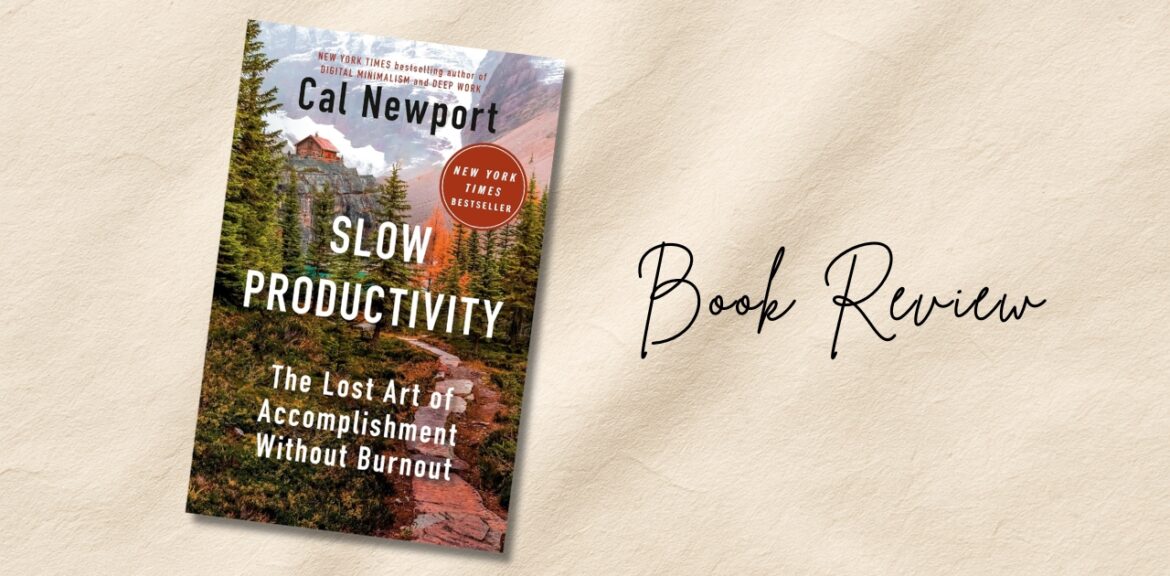
I got interested in Slow Productivity after reading three of Cal Newport’s other books and as a listener to his podcast, where he mentioned this as his latest. As someone who lives a minimalist and intentional life, this work philosophy immediately appealed to me.
The core idea of slow productivity
The author defines knowledge work as the economic activity in which knowledge is transformed into an artifact with market value through the application of cognitive effort. Slow productivity, then, is a philosophy for reorganizing that work in a sustainable and meaningful way that’s built on three principles:
- Do fewer things.
- Work at a natural pace.
- Obsess over quality.
Importantly, slow productivity doesn’t ask you to extinguish ambition. It’s not about doing less because you care less, but more about doing less so what you do is actually good.
Key takeaways and what I liked about Slow Productivity
1. Money as a tool and not the goal.
As a virtual assistant/freelancer working remotely, this book resonated with me. In our field, we’re constantly bombarded with social media posts about six-figure earners. This isn’t about demonizing earning more, since all of us want to earn more money.
Yet, in the industry I work in, people always flex about earning such amounts without really being transparent about the work done behind the scenes, which most of the time means sacrificing other parts of your life such as your health, well-being, and relationships.
Moreover, regardless of what kind of worker you are, the lesson that stuck with me most is that money shouldn’t just be the goal itself, but a tool to gain more freedom in your life.
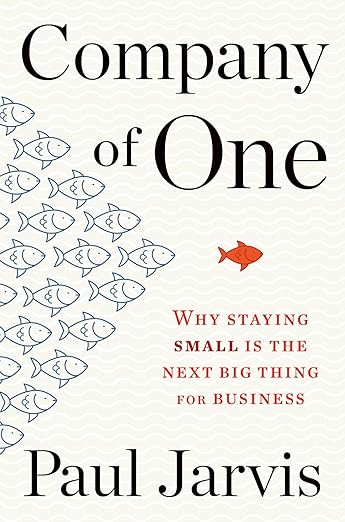
He also mentioned about the book, Company of One by Paul Jarvis, which is in my bucket list of books to read where it’s about creating a profitable and sustainable business by staying small and avoiding growth.
2. The Jewel and Alanis Morissette example.
I thought about this when I read the part about the talented singers, Jewel and Alanis Morissette, where music producers offered them million dollar contracts that would have come at the expense of their creativity, their time, and their well-being.
The two singers chose instead to slow down, improve their craft, and slowly reach the peak of their careers without compromising the other parts of their lives.
Though there are some criticisms about why the author included Jewel and Alanis Morissette in the book since they aren’t knowledge workers, I get the point he’s making by using their example.


3. Obsessing the quality of your work.
At the same time, I like the distinction he draws about obsessing over the quality of your work, but not sliding into perfectionism. Sometimes, all we want is to start on a project or goal immediately, without thinking about the long process or journey it takes to master the craft in the first place.
It’s not just about doing quality work for the sake of producing it, but using it as a tool to leverage yourself and gain more freedom as you provide more value to others. This concept is similar to what Cal Newport talks about in his book, So Good They Can’t Ignore You.
3. The reader survey that hit home.
In Chapter 1, the reader survey responses that the author shared hit home.
The benefits of technology have created the ability to stack more into our day and onto our schedules than we have the capacity to handle while maintaining a level of quality which makes the things worth doing.
I think that’s where the burnout really hurts when you want to care about something, but you’re removed form the capacity to do the thing or do it properly and give it your passion and full attention and creativity because you’re expected to do so many things.
I agree with this. Technology such as social media and communication platforms has given us more work to fit into our days than we have the actual capacity to handle and that’s where burnout happens.
The author mentioned about Jonathan Frostick, a corporate employee who survived a heart attack in 2021 as a result of work burnout and stress. After his recovery, he said that he’ll no longer spend Zoom meetings all day. That struck me as well since in this time, work is a source of stress for some people and technology has somehow contributed to this.
4. Office life versus remote work life.
I had the opportunity to work both in an office and remote setting. This is where I was able to differentiate and understand the points the author conveys. When I was still working on-site for 6 years, pseudo-productivity is something I’m guilty of, since I’d rather look busy as some managers constantly roam around the office to check if you’re working. Yet, the work I was actually doing was just busywork meant to make me look productive. People also cared more about accomplishing the task within the day without really looking at the quality of the output.
Likewise, I’ve experienced 12-hour workdays. I can attest that it’s a recipe for burnout, failure, and an inability to focus or produce anything good. Over time, errors in the work would surface, which meant double work and redoing things from scratch. Haste indeed makes waste.
In contrast to my current work as a virtual assistant, my current client doesn’t know anything about slow productivity, but she values quality work over fast work. The client would rather I do one task well than rush through everything in a day just to clear a to-do list without caring about the quality behind it. If more managers and employers operated like that client, knowledge workers wouldn’t be as burned out as they are now.
Where the book falls short
1. Limited examples for the average knowledge worker.
Most of the book leans on criticizing the pseudo-productivity we see in office jobs and how toxic it’s become, which is valuable, since this rarely gets discussed openly in an office setting. However, the author is upfront in the introductory chapter that not every job can embrace this method, and the examples he gives lean toward people with more autonomy than the average employee has.
2. The corporate example problem.
The only real corporate case study is Basecamp, which isn’t a realistic model for most companies. For the context, Basecamp uses a deliberate seasonal cycle to prevent employee burnout.
Having worked both on-site and remotely, I can see why. In an office setting, you’re often measured by visibility and not by the output, so the kind of autonomy Basecamp gives its employees would be hard to implement when managers are used to monitoring people physically.
3. It doesn’t address the root cause.
Pseudo-productivity, overwork, and burnout are products of capitalism. No matter how much we might want to apply Cal Newport’s methods, the underlying incentives won’t shift as long as those at the top keep prioritizing maximization of shareholder’s wealth over its people.
4. Overlapping ideas from Cal Newport’s other books.
This is my fourth Cal Newport book and I could connect a lot of what he discusses here to Deep Work, So Good They Can’t Ignore You, and Digital Minimalism. Because of that, some of his suggested methods didn’t feel new to me, but if this is your first Newport book, these ideas will likely feel fresh and worth reflecting.
Conclusion
I recommend this book to knowledge workers who want to improve their productivity in a different way, where one doesn’t equate busyness with being good at your job.
I’d recommend it especially to fellow remote workers, since you likely already have more room to apply these principles.
For office workers, this book might be harder to resonate with, not because the ideas aren’t valuable, but because the environment itself often won’t allow it, based on my 6-year office job experience.
Still, take what’s useful and leave what isn’t. Not every concept the author suggests will fit into your life or your work setup and that’s totally okay. The goal isn’t to follow his framework perfectly, but to use it as a starting point to ask yourself what you actually want out of your work.
At the end of the day, slow productivity isn’t really about working less, but more on being intentional with the time and energy you do have, so that what you produce, and who you become in the process, actually means something.






Leave a Reply