
Photo by Rodolfo Clix
Last week, I watched Asian Boss’ almost 50 minute video on why the Philippines’ birth rate is crashing faster than Japan’s. I got intrigued in the first third as it went back further to our country’s history, all the way to pre-Hispanic Philippines, before walking through three centuries of Spanish colonization and how that history built the version of womanhood, marriage, and family size most of us grew up inheriting.
The video doesn’t stop at colonization as the explanation. It mentioned the demographic transition which is the same pattern that’s unfolding across the globe as countries urbanized. Children stopped being economic assets the moment families moved to cities and had to pay for school instead of farm labor.
My family’s own numbers
Somehow, I didn’t need a national chart to see the demographic transition as I have my own family tree to show as an example.
On my mother’s side, I traced it back using familysearch.org which is a genealogy site. My maternal great grandfather was one of 18 siblings. My maternal grandfather was one of 16. This was just what a family looked like in the Philippines during the 19th century and 1st half of the 20th century before urbanization caught up with everyone.
By my parents’ generation, the numbers had already cut in half. My father came from a family that was supposed to have 10 children, but lost 2 during World War 2, leaving 8. My mother’s side had 5 which is still large by today’s standard, but a fraction of what came before.
Then there’s my generation. Most of my cousins were at an average of 2 to 4 siblings.
Laying out the numbers which are 18, 16, 8 and 5, then 2 to 4 or zero, itt’s four generations of the different families. Yet, watching the math, what the video describes play out in real time. Even thought the war cut into the numbers once, the economics and personal choice did the rest.
The pageant idol I don’t buy
Where the video lost me was the part about beauty pageants becoming a wholesome aspirational symbol for the NBSB generation. The idea is that pageant queens evolved from the modest Maria Clara archetype into career-driven and opinionated women. At the same time, it pointed out that this shift lines up with what young Filipinas now want for themselves.
Somehow, I don’t buy this point.
It has been an open secret that Filipino pageant culture has long carried a reputation alongside the crowns and sashes that pageant circles, especially at the higher levels, function as access points for elite men and politicians. I can’t verify that claim, but it’s said by enough people that I’m not willing to treat beauty pageants as a clean feminist symbol for a generation of women trying to opt out of old expectations.
Moreover, holding up beauty pageants, an industry built on physical judgment, sponsorship money, and proximity to powerful men, as the model for female independence feels like swapping one template for a shinier one. Maria Clara asked women to be modest and waiting. The pageant version asks them to be photogenic and articulate, while still ultimately being looked at and ranked by a panel.
If the NBSB generation wants role models for independence, I’d rather look at the women actually building things behind the scenes without the audience.
Who actually gets to choose fewer kids
The video frames the falling birth rate mostly as a story about education and career ambition. It points out that Filipino women now are more educated, more financially independent, so they’re choosing smaller families or none at all. I definitely agree with that, but I think it skips over something I’ve noticed in what I’ve observed in a societal lens and that this shift doesn’t look the same across income levels.
From what I’ve seen, it’s the middle class doing most of the opting out. For middle class couples who want to have kids, they tend to have 1 or 2 kids because they’re sending them to private schools. In these institutions, tuition alone can run into millions of peso money over a child’s school life. Compared it to public schools, education there is free.
On the other hand, lower income families often keep having more children because there’s a common belief that more children means more chances and more hands to eventually help the family out of poverty. They’re okay with sending their children to public schools which is free, but lacks the quality a child can get from studying in a private institution which is evident in the education and literacy crisis the Philippines is currently experiencing. Likewise, the government’s 4Ps program gives some cash support per child for this income category.
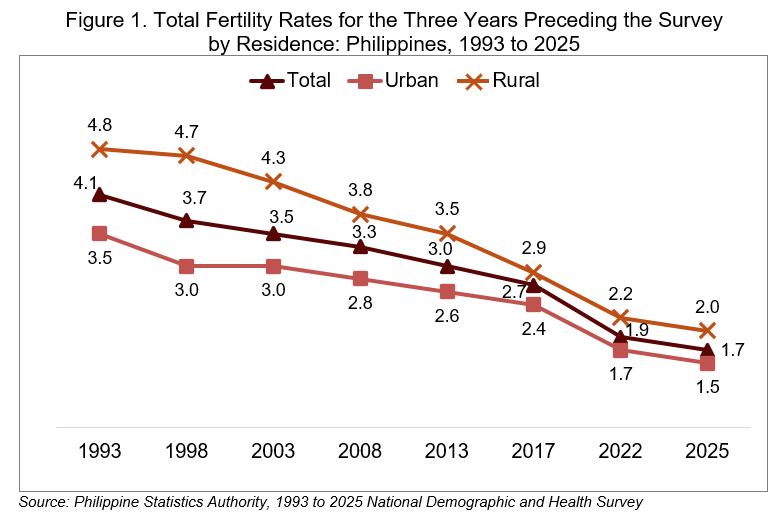
This isn’t just my impression as the Philippine Statistics Authority’s own 2025 survey backs it up. Fertility dropped from 2.8 children among the poorest households to 1.1 among the richest and from 3.1 children among women with only some primary education to just 1.1 among college graduates. Wealth and education don’t just correlate with the national average, but they’re driving two very different birth rate stories happening inside the same country.
What the Asian boss video missed
There’s also a piece of context the video, being a foreign outlet looking at the Philippines from the outside, wouldn’t necessarily catch. The middle class isn’t just choosing fewer kids because they can afford private school.
Most of them aren’t relying on PhilHealth alone. PhilHealth provides foundational healthcare support, but often doesn’t cover the full cost of treatment, particularly in private hospitals, where professional fees and room charges can leave patients paying a significant balance out of pocket. Government hospitals have overcrowded wards and long waiting times, so families who can afford to go elsewhere do. That means layering an HMO on top of PhilHealth for consultations and checkups, then adding private health insurance on top of that for major medical events.
HMO premiums from major providers alone run from Php15,000 to 80,000 annually per person, before you even get to life insurance, which most financially literate families also carry. Multiply that across a household of four and you’re looking at a substantial recurring cost every year which money that could otherwise go toward raising another child, or simply doesn’t exist if you already have one.
The contrast with other countries in the region is worth noting like Thailand’s universal coverage model gives citizens free healthcare through government-funded programs, while Malaysia heavily subsidizes public care, with locals paying just one to five pesos equivalent for a government hospital visit. A Thai or Malaysian middle-class family deciding whether to have another child isn’t simultaneously calculating HMO premiums, life insurance, and private school tuition as non-negotiable baseline costs. Filipino families are. That difference in what neighboring governments actually deliver to their citizens shapes how many children people feel they can afford to raise.
When Philippines’ national health insurer can’t reliably spend the money it already has, middle class families don’t wait around to see if it improves. They buy their own coverage and absorb the cost themselves.
At the same time, they’re watching billions of pesos meant for public infrastructure disappear into ghost flood control projects.
The Department of Finance reported that economic losses from corruption in flood control projects alone may have averaged Php118.5 billion annually from 2023 to 2025. That’s money that should have gone toward roads, schools, hospitals, and the public systems a middle class family might otherwise lean on instead of paying out of pocket for private alternatives.
When trust in public institutions erodes this badly, every family expense starts to feel like something you have to cover yourself because you can’t count on the government to cover it for you. Private school and healthcare options isn’t just a preference, but it becomes insurance against a public system that people no longer believe will hold up. Fewer kids becomes one more way of keeping that insurance affordable.
Why this matters later
The video’s core warning is what economists call the aging-before-becoming-rich problem. Countries like Japan got old and stopped having as many kids only after they’d already become wealthy, so they had the money to build pension systems, elder care, and healthcare infrastructure to manage the consequences.
The Philippines is doing the opposite, aging and losing its birth rate before it has built any real wealth cushion. The video points to a minimum wage in Manila still sitting around $11 a day, no universal pension system covering most workers, and a 2030 deadline (Just a few years out) when elderly dependents start becoming a significant burden on the working-age population.
I agree with that warning, but I don’t think it’s just bad timing or bad luck. The reason the Philippines never built that wealth cushion is because of the same government failures the video doesn’t connect back to its own thesis.
So, if we’re going to be honest about why the Philippines is aging before becoming rich, the answer isn’t only that birth rates fell too fast. It’s that the systems meant to catch us as we age were never properly funded to begin with, because the people in charge of funding them kept stealing from the pot.
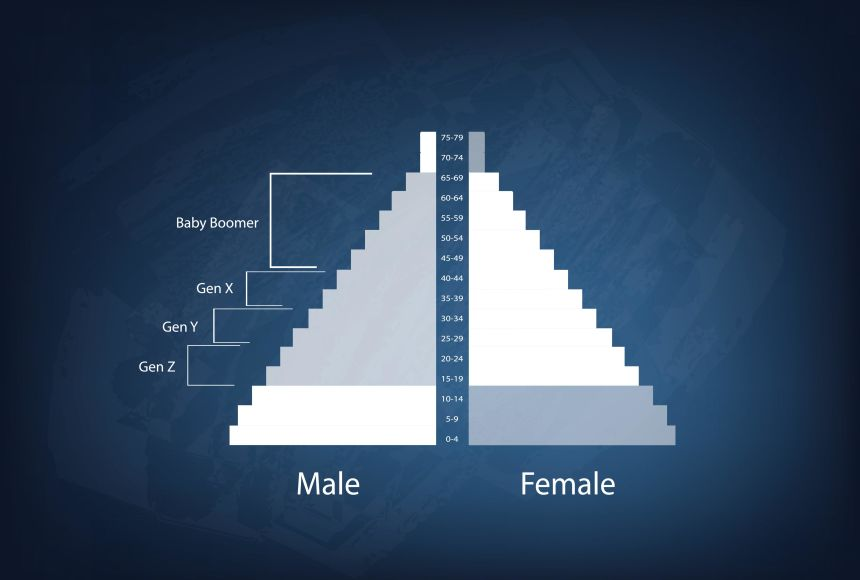
A population pyramid is just a chart showing how many people fall into each age group, stacked from youngest at the bottom to oldest at the top, split by sex. A healthy growing country looks like a wide-based triangle, lots of children and young workers at the bottom, fewer older people at the top. A pyramid with a wide base and narrow top suggests a growing population, while a narrow base where each succeeding age group gets smaller than the last signals a declining one. The shape tells you who’s coming up behind the working-age population to eventually replace them, and who isn’t.
Most of the Gen Zs and Millenials are still in our prime working years, so the strain isn’t hitting us directly yet. The Philippines’ working-age population is currently dominant and projected to remain strong through 2050. This is what demographers call the demographic dividend which is a window where there are more workers than dependents. Right now, the math still works in our favor.
The real cost lands later, when we’re the ones getting old. The share of Filipinos aged 65 and older is projected to rise from 5.7 percent in 2025 to 11.2 percent by 2050. This is nearly 15 million older persons.
By then, the generation we didn’t have, the smaller cohort of Gen Alpha and whoever comes after them, will be the working-age base expected to fund our pensions, staff our hospitals, and keep the economy running. A narrower base at the bottom means fewer people carrying more weight at the top. If the Philippines never builds a real social security and elder care system in the meantime, that weight falls first on individual families, on however many children we did have, to personally support aging parents with little institutional backup.
What I’d rather see instead
I don’t think the answer is convincing more people to have kids they don’t want, in an economy that already makes it hard enough to raise the ones we do have, not when oligarchs and corrupt officials keep getting richer while ordinary families absorb the cost of broken promises, and not when the people most pressured to have more children are often the ones with the least support to raise them well.
What I’d rather see is an open mind. Some of us are breaking cycles our parents and grandparents never had the chance to question and cycles of marrying out of obligation instead of choice and of having children because that’s just what you did. It’s okay to heal your inner child instead of repeating what was handed to you. It’s okay to end the cycle in whatever way that looks like for you such as having fewer kids, no kids, or kids on your own timeline.
Yet, whichever path you choose, prepare for your own retirement. The old assumption in Filipino culture was that your children would take care of you when you got old, so you didn’t need to plan much beyond that. That assumption is always shaky and it’s only getting shakier with a smaller generation behind us and a government that has shown no urgency in making real change. If you’re having kids, don’t assume they’ll be your retirement plan. If you’re not having kids, you definitely can’t lean on that fallback. Either way, the responsibility to prepare and invest in whatever that looks like for you, falls on you now and not on a system that was never built for this nor on the children who didn’t ask to be anyone’s retirement plan.
Life is already hard enough here. The least we can do, as a country and for each other, is stop making it harder. Let’s make it easy for everyone, at the very least.




Leave a Reply