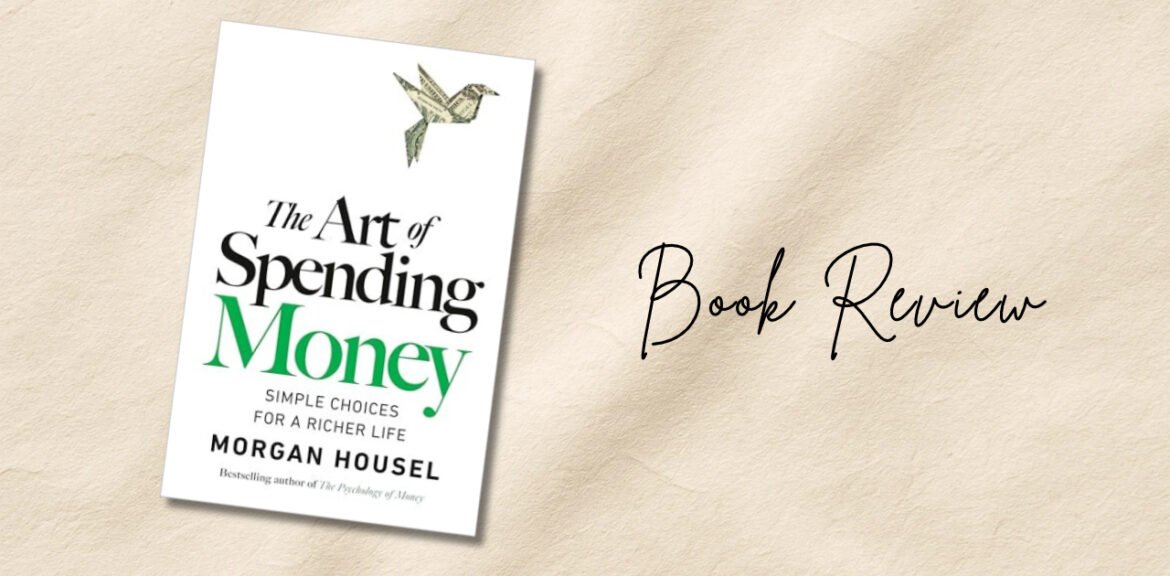
Before this year, I’d only read one book related to finance and money. It was written by a local author and I read it sometime in 2016. I found the methods overwhelming because they seemed to assume the same approach would work for everyone. I’d also heard about a popular finance book (Hint: it talks about a dad), but some of the advice people shared and the reviews I came across put me off. At that point, I decided to stop reading books about money and finance.
That changed this year when I came across The Art of Spending Money by Morgan Housel through Marissa Zheng’s YouTube channel, A to Zen Life. The book got me thinking about a question I wanted to explore in this review. How do we know when spending money is actually making our lives better?
What is the Art of Spending Money about?
The Art of Spending Money is about why we spend the way we do and how to tell which purchases actually make our lives better. The author, Morgan Housel, looks at how our expectations and what we see other people buying can change what feels worth paying for.
The author also writes about the other side of spending. Some people get used to saving that they hesitate to spend even when they can afford something that would make their daily life easier or more enjoyable. What feels worth paying for depends on what you need, what you enjoy, and what gives you peace of mind.
What makes this book different from a typical finance book is how much it emphasizes to the personal side of money and that personal finance is more personal than the finance side. A purchase that makes sense for a person might feel like a waste of money to someone else. We have different priorities and values and what feels worth paying for depends on what matters to each of us.
Morgan Housel also the author of The Psychology of Money which is the first book he wrote. I haven’t read yet. The first finance book I read a decade ago made me overwhelmed because its advice seemed to assume that everyone should handle money the same way.
As for The Art of Spending Money, the book’s approach made me ask myself, “What do I actually want my money to do for me?”
What the book made me rethink about spending
I like how the author uses stories to make his points. Specifically, the story of the Vanderbilt family stood out to me. I’d never heard of the family before, but parts of th family’s history seemed familiar. Some of their spending habits reminded me of people I know here in the Philippines.
Another story that stayed with me was the author’s comparison of two professional athletes, Antoine Walker and John Urschel. They took different paths with the money they earned. What struck me was how much Walker’s spending came to control his life, while Urschel used his earnings to give himself more choices over how he lived.
As an advocate of living a minimalist and intentional life, some of the book’s ideas aren’t knew to me. Still, I like the reminder of how easily we can fall into the comparison trap, especially on social media and the societal pressures to keep up with the Joneses. Seeing what someone else has can make us want something we hadn’t even thought about buying.
The part I wish more people knew about is the author listing the 15 levels of financial independence. Reading through them made me think about where I am now, how easy it can be to spend years at levels one, and what it would take for me to reach level 15. As much as I’d like to reach that point.
Some examples are not relevant in the Philippines
When I looked at the numbers for the Philippines, I reconsidered what it means to stay at the same level of financial independence. In a 2021 survey by the Bangko Sentral ng Pilipinas, about two in three respondents said they earned too little to save regularly. How quickly someone moves from one level to the next can depend on something as basic as how much is left after paying for food, rent, transportation, and other living expenses.
There’s also the question of how many people depend on that income. A Philippine study on ageing found that 58% of older Filipinos received financial support from children living in the country. Think of someone who sets aside part of each paycheck for a parent’s groceries and living expenses. Their own savings might grow slowly, even as that money gives their parent a more secure life. That’s what I would have liked to see explored more in the book. When one person’s income supports two households, what does financial independence look like for them?
Who should read The Art of Spending Money?
I wish I’d read a book like this when in college as a Finance major. The finance subjects I took taught me the theories behind financial management, but I had little practice applying them to decisions I’d face in my own life by the time I started earning money.
That’s why I’d recommend The Art of Spending Money to high school students, college students, and new college graduates. Even before you earn your first paycheck, it’s worth reflecting about what you want that money to do for you. How much would you like to set aside? What would you be happy to spend on? Would your answer change if your friends were spending differently?
I’d also recommend this book to anyone who wants their money to give them more choices in life. It’s easy to let other people’s idea of success shape what you think you should want.
Lastly, what I appreciated most about this book is that it gave me a better question to ask myself before I spend: if no one else knew about this purchase, would it still be worth it to me?





Leave a Reply