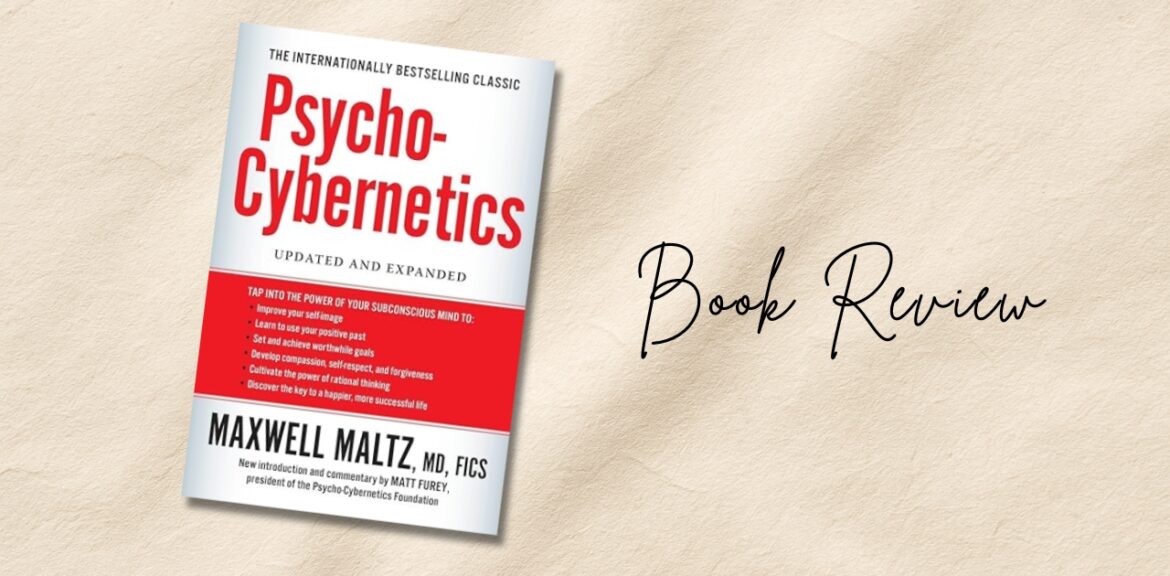
In a sea of famous self-help books, I’d never heard of Psycho-Cybernetics until my client from the United States had me listen to it through Audible. It was part of my task to pull ideas we could turn into my client’s social media content, using the book’s ideas. For context, I’m the client’s virtual assistant from the Philippines.
On Audible, I listened to the original version and finished the audio book in three days as I was fitting it into my daily routine rather than listening straight through. Weeks later, I bought the book, but it’s the Updated and Expanded version, with an introduction, conclusion, and commentary by Matt Furey, president of the Psycho-Cybernetics Foundation.
Book overview
The author leans on real cases from his practice as a plastic surgeon to make the self-image idea concrete, then backs it up with science. However, these are studies and references from the 1960s and earlier, so this isn’t a book citing recent research and it’s a product of its time.
Likewise, the author’s background is where the book starts. As a plastic surgeon, he noticed something odd in his practice where some patients got a new face and walked out with a new sense of confidence while others, even after a successful surgery, they still felt ugly and inferior and still carried the same insecurities they had before the operation. The patient’s face changed, but the person inside didn’t.
This gap is what the author spent the rest of his career trying to explain. He concluded that the real problem was never the imperfections, but it was the self-image sitting underneath which is the private picture someone carries of who they are.
The core idea
The book’s main theme is that your self-image sets the boundaries of what you can achieve. Hence, you will unconsciously act in ways that stay consistent with it, whether or not that self-image is accurate. Dr. Maxwell Maltz borrowed the term “cybernetics” which means steersman from the Greek word. The term also came from the science of automatic guidance systems, which is the mechanism used in missiles and torpedoes, to describe how the human brain works the same way. Each person has a built-in mechanism that steers you toward a goal and self-corrects along the way, but it can only aim at whatever target your self-image has set. Change the self-image and the whole system starts steering somewhere new.
Now, this is where the updated and expanded book comes in. Some sections have an added commentary from Matt Furey which is meant to bridge the original material with how we live and work today. Yet, the update isn’t just additions as some parts were also removed. I noticed this myself while reading the updated and expanded book version, since I’d already listened to the original through Audible. I kept looking forward to sections I remembered from the audiobook that simply wasn’t there in the updated book version.
As for the substance, some ideas repeat across chapters and a few explanations come across as shallow rather than fully worked through. Also, it leans on Christianity in parts, which might feel a bit out of place if you’re not religious like me, but it didn’t take away from the core ideas for me. Still, overall, the book holds together and makes sense as a whole.
Beyond the stories and science, Dr. Maxwell Maltz also gives practical exercises such as relaxation techniques, mental rehearsal, and a structured 21-day practice period which is meant to help the self-image shift. As mentioned in the book’s intro, it’s meant to be experienced and not just to be understood on paper.
Who the book is for?
Psycho-Cybernetics is for anyone who wants to improve their self-image and self-esteem. It’s for the person who knows what to do but can’t act on it or who sabotages their own progress right when things start going well. If your circumstances changed but you still act like the same insecure version of yourself, this book is speaking to you.
It’s also useful for people in fields where confidence shapes the outcome such as sales, public speaking, entrepreneurship, or creative work. The author keeps mentioning the book where his patients whose success or failure had nothing to do with skill or looks, and everything to do with what they believed about themselves.
On the other hand, it’s less suited for readers who want current and evidence-based psychology. This book is old-school. However, if you’re open to an older and more philosophical style of self-help which is backed by an interesting professional origin story, you might be open to exploring this book.
Where the book lost me.
One part I disagree with was the author’s advice to face fear head-on by throwing someone straight into what scares them. He uses the example of learning to swim by being thrown into the water. I’m not a swimmer and I’ve survived a sinking boat without a life vest. It was a bad experience and this advice made me disagree rather than be convinced.
The author applies the same logic to trauma and abuse. He suggests facing the person who hurt you or returning to where it happened, as a way to heal. I also don’t agree on this. I believe that for someone who has lived through abuse, going back to that person or that place isn’t healing and can even cause more harm.
This is a 1960s book which written before we understood trauma the way we do now. I don’t think the author meant harm by it. Yet, reading it today, these parts felt outdated and reckless, which is why they stood out as some of the weakest points in the book, in my opinion.
Personal impact
It took me a month to finish reading the book. The author’s advice is easy to use in my case as someone who has self-image concerns relating to body dysmorphia and past eating disorder issues. Hence, the personal impact might be a case-to-case instance for other readers.
The advice that impacted me and changed my mindset are the following:
- To live a reasonable and satisfying life, one must have an adequate and realistic self-image that you can live with. All of our actions, feelings, behaviors are consistent with our self-image or how we see ourselves.
- You must not wait to act until you have proof. You must act as if it’s there and it will come through.
- Humans act, feel, and perform in accordance with what he imagines to be true about himself and his environment.
- Your mental picture of yourself is the strongest force within you.
- Feelings of inferiority originate not so much from facts or experiences, but our conclusions regarding facts and our evaluations of experiences.
- The memories of past failures, errors, mistakes, and humiliations don’t harm us as long as our conscious thought and attention are focused on the positive goal to be accomplished.
- The unhappiest beings are those who insist on reliving the past, over and over in imagination, continually criticizing himself for past mistakes and continually condemning himself for past sins.
- When once a decision is reached and execution is the order of the day, dismiss absolutely all responsibility and care about the outcome.
- By living today well, you do the most within your power to make tomorrow better.
- Happiness is purely internal. It’s produced not by objects, but by ideas, thoughts, and attitudes which can be developed and constructed by the individual’s own activities, irrespective of the environment.
- A big strong man doesn’t feel threatened by a small danger. A little man does. In the same way, a healthy strong ego, with plenty of self-esteem, doesn’t feel itself threatened by every innocent remark.
- The way to make a good impression on other people is: Never consciously try to make a good impression on them. Never act, or fail to act, purely for consciously contrived effect. Never wonder consciously what the other person is thinking of you, how he is judging you.
- Practice without pressure and you will learn more efficiently and be able to perform better in a crisis situation.
- You will find yourself feeling self-confident, because self-confidence is built upon memories of past successes.
- Develop a nostalgia for the future instead of for the past if you want to remain productive and vital. Develop an enthusiasm for life, create a need for more life, and you will receive more life.
Read it or skip it?
I recommend this book. As I mentioned earlier, it’s for anyone who feels capable on paper but stuck in practice and who knows what to do but can’t act on it, especially if you work in a field where confidence shapes your outcomes.
This is a book I wish I’d read as a teenager or in my 20s. I believe I could have improved my self-image much earlier if I’d read it back then. I plan to read it once a year going forward. A lot of the self-help concepts we hear today feel like they trace back to this book.
All in all, my advice is to take lessons and takeaways from this book that applies to your life and leave out what doesn’t work for you. What matters is you walk away with the pieces that actually help.






Leave a Reply